Galaxy Collision Simulation Engine
Date of Project Completion: 2025-5-08
Tags: Python, 2D Simulation, Barnes-Hut Tree, Euler Method
Galaxy Collision Simulation Engine
Using a Barnes-Hut algorithm to simulate multi-body particle interactions in gravity, this program creates simulations multiple galaxies and their interactions over time. The program randomly places up to 100,000 particles around a center point of each galaxy, and its next position is calculated with the Euler method.
Rendered Demo
Simulation of 100,000 Particles in 2 Galaxies.
Initial Implementation
To begin this, I started a 5 particle simulation given to me with the assignment, and modified the code to support than 5 particles. I also created a Particle class in the hopes of improving programming efficiency. Once I could simulate multiple particles, I wanted to try creating two small clusters of particles with only around 10 particles each. This was tricky, as I was manually setting weights and velocities and the particles would often fall to the center or fly off. I eventually added a center mass that was much heavier than the other particles, as this was the only way to keep the particles in place.
At this point, I tried to assign the particles a more circular location, by assigning them a random radius and angle instead of an x and a y, but then converting those values into rectangular coordinates. I then spent too much time trying to make a more optimal rotational velocity, by adding a tangential velocity that would increase as it got closer to the center.
Once I had this implemented, I tried working around one hundred particles. I noticed that my computer could no longer simulate in real time and needed to implement some sort of structure to improve efficiency.
Grid Implementation - Additional CPU Cost
My original plan was to implement the 1024x1024 grid structure. I was a bit confused about its implementation because it would add around 100,000 objects and that many calculations to the grid for each calculation. I tried to implement it, which is shown in my grid.py function. It first calculates the inner forces within each particle, and then the center of mass of each grid square. Then it grabs the other centers of masses and calculates an average force based on that value. The issue with this implementation was that the time that it took to calculate each grid's center of mass felt like it was much higher, and added a lot of time to my simulation. I also encountered a strange issue where the orbiting bodies would be “pulled” by my center masses much more than they should have been, and would create an inaccurate collision simulation.
Barnes-Hut Tree
I decided that for my computer, the most efficient implementation would be a Barnes-Hut tree, so I tried to implement this using the diagrams from the assignment. In an attempt to improve efficiency, I tried to implement a function where upon an update to a particle's location, it would determine if it was out of bounds of its parent, upon which it would remove itself and its center of mass from the tree. However, I had a lot of trouble implementing this and was struggling to get it to work. I was having issues with divide by zero errors as well as the grids not working properly, and was also struggling with the time complexity as I scaled up the number of squares.
I did some more research on the Barnes-Hut Tree and I found an article written by Tom Ventimiglia & Kevin Wayne, who described the Tree in more detail. With this implementation, I was able to create the simulation included in this project.
The article discusses the idea of a calculation threshold, theta, that determines when to recurse down the tree for calculations and when to stop and use an average center of mass. This is based on the width of the parent square divided by the distance of the object. A theta of 0.5 is standard, and zero is equivalent to brute force calculations.
One thing that I was unsure about while creating this was how I would implement the updating of the tree. I had repeatedly tried restructuring and recalculating tree data on updates, but this never really seemed to work. From research I found online, it seemed that the best option was to simply tear down and rebuild the tree for each frame.
Processing Speed
Compared to brute force implementation initially, my implementation has significant speedups. It is able to calculate the positions in the realm of thousands of particles about multiple times faster than the brute force implementation. However, the processing time is still very high, in the range of several hours, when hundreds of thousands of calculations are made, even with a higher value set for theta. If I could split up the task, and use the multiple cores on my CPU, then I could probably make the program run much faster, but attempting to implement caused multiple errors in Python. While I did eventually make my completed implementations, I would be happy to know how I could improve this programs efficiency in any way.
Key Files to Look At
- 100k-Final.mp4 - This is my final implementation of 100,000 particles. It's a little long, but you can see the multiple collisions of the centers and how the particles spread out.
- MultipleParticles_bh-new.py - This is the code that finally got the implementation working. Note the setup and teardown of the tree on each update. You can test it quickly by changing the “num_particles” property to a number less than a thousand(must be divisible by 2) and having it run.
- newTree.py - This is the Barnes Hut tree that I got to work the best, and would simulate the most faithfully.
- Particles.py - This file holds all of the particle classes used in the simulation. Each center mass was a standard particle, but the orbiting particles were StarParticles that had special functions to give them random positions around the center.
- Other Files - Other videos and python files included show previous or unsuccessful iterations of the project. You can see the various tree files that couldn't simulate the particle positions properly, as well as my grid calculations and how they added a lot of time.
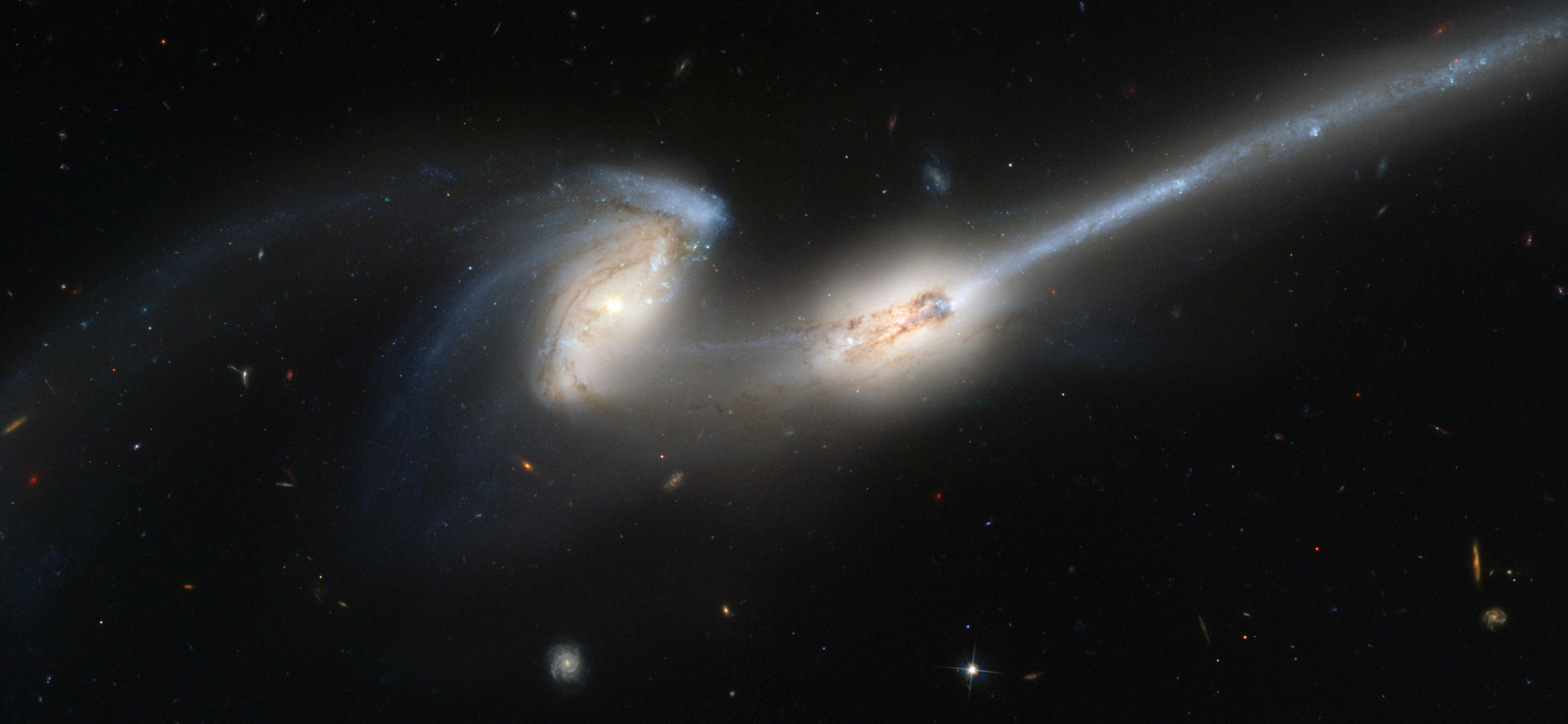
Cover Image: By NASA, H. Ford (JHU), G. Illingworth (UCSC/LO), M.Clampin (STScI), G. Hartig (STScI), the ACS Science Team, and ESA - APOD 2004-06-12, Public Domain, Link